
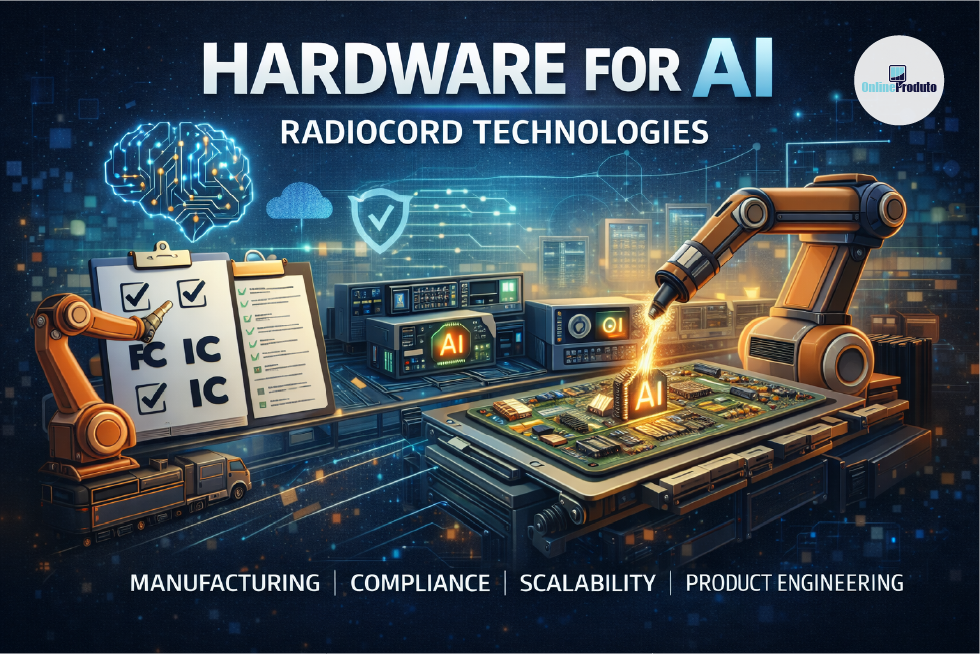
When most people talk about Hardware for AI Radiocord Technologies, they usually focus on processors, GPUs, or SDR systems. That’s important, sure—but it’s only half the story. The real challenge begins after the prototype works. Turning an idea into a scalable, manufacturable, and compliant product is where things get complicated, and honestly, where most projects struggle.
In today’s fast paced digital world, businesses are not just building AI demos—they are building real products that must operate reliably in the field. These products must support ai integrations, handle real time workloads, and still meet cost targets for mass production. That requires a completely different level of thinking.
This is where companies like Radiocord Technologies come into play. Their approach focuses not only on building hardware but also on ensuring that systems are production-ready, compliant, and optimized for long-term deployment.
The Missing Layer: From Engineering to Productization
Designing AI hardware in a lab is one thing. Shipping thousands of units is another. The transition from prototype to production introduces challenges that are often underestimated.
These include:
- Component sourcing and lifecycle management
- Manufacturing consistency and yield
- Thermal and environmental reliability
- Firmware stability across hardware revisions
- Regulatory approvals and certifications
Without addressing these factors early, even a technically strong design can fail commercially. This is why Hardware for AI Radiocord Technologies must be viewed as a full product lifecycle, not just a technical stack.
Design for Manufacturing (DFM) in AI Hardware
Design for Manufacturing is one of the most overlooked aspects of AI hardware. Engineers often optimize for performance, but manufacturing teams care about repeatability, cost, and assembly efficiency.
For example, a complex pcb design with tight tolerances may work perfectly in a prototype, but it might lead to low yield rates during production. Similarly, using rare or single-source components can create supply chain risks.
Good DFM practices include:
- Standardizing components wherever possible
- Reducing PCB layer complexity when feasible
- Designing for automated assembly
- Planning test points for quality assurance
This is especially important in iot systems, where devices are often produced in large volumes and deployed in diverse environments.
Firmware Lifecycle and Device Stability
Firmware development doesn’t end when the product ships. In fact, that’s when it becomes even more critical. AI-enabled devices require ongoing updates to improve models, patch vulnerabilities, and enhance performance.
Strong device firmware strategies include:
- Over-the-air (OTA) update capability
- Version control and rollback mechanisms
- Secure boot and encryption
- Hardware abstraction layers for scalability
In many cases, firmware becomes the long-term differentiator. Two devices may have similar hardware, but the one with better firmware will outperform in the real world.
AI Model Deployment on Edge Devices
Deploying machine learning models on edge devices is not straightforward. Models must be optimized for size, latency, and power consumption.
This involves techniques like:
- Model quantization
- Pruning and compression
- Hardware-specific optimization
The goal is to achieve high performance while staying within hardware limits. This is particularly important for battery-powered devices and remote deployments.
Compliance and Certification: A Critical Step
One of the most complex aspects of Hardware for AI Radiocord Technologies is compliance. Products must meet regulatory standards depending on the region and application.
Common certifications include:
- FCC (United States)
- IC (Canada)
- CE (Europe)
- RoHS and environmental standards
AI-enabled RF devices face additional scrutiny because of their wireless capabilities. Testing must ensure that devices do not interfere with other systems and operate safely under all conditions.
This process can be time-consuming and expensive, but skipping it is not an option.
Scaling AI Hardware for Mass Production
Scaling from hundreds to thousands of units introduces new challenges. Cost optimization becomes critical, and even small inefficiencies can have a big impact.
Key considerations include:
- Reducing Bill of Materials (BOM) cost
- Optimizing supply chain logistics
- Ensuring component availability
- Streamlining assembly processes
For ai systems, scaling also means ensuring consistent performance across all units. Variations in components or assembly can affect accuracy and reliability.
Real-World Example: Industrial IoT Deployment
Consider an industrial monitoring system that uses AI to detect equipment failures. The system includes sensors, an edge processor, wireless connectivity, and custom firmware.
In the prototype phase, everything works well. But during deployment, new challenges appear:
- Temperature variations affect performance
- Network connectivity is inconsistent
- Firmware updates fail in remote locations
These issues highlight the importance of designing for real-world conditions from the start. It’s not just about making something work—it’s about making it work everywhere.
Pros and Cons of Production-Ready AI Hardware
Pros
- Reliable real-time performance
- Scalable architecture
- Improved product lifespan
- Better return on investment
Cons
- Higher upfront development cost
- Longer time to market
- Complex certification processes
- Ongoing maintenance requirements
Practical Tips for Building Hardware
- Start with a clear use case and avoid overengineering
- Design for production from day one
- Invest in strong firmware architecture
- Plan for compliance early in the process
- Test in real-world environments, not just labs
FAQs
AI hardware must support real-time processing, higher data throughput, and advanced compute capabilities while maintaining efficiency.
Firmware controls how hardware operates and enables updates, security, and performance optimization.
It is essential. Without proper certification, products cannot be legally sold in many markets.
Conclusion
Hardware for AI Radiocord Technologies is not just about selecting components—it’s about building complete, scalable, and production-ready systems. From pcb design and firmware development to compliance and mass production, every stage plays a critical role in success.
As demand for iot device innovation and intelligent systems continues to grow, companies must adopt a holistic approach to hardware development. The future belongs to those who can combine ai integrations with practical engineering, delivering systems that are not only smart but also reliable and scalable.
And honestly, that’s where the real competitive advantage lies—not just in innovation, but in execution.
Visit: Onlineproduto